Pages

Oil and Gas Forum

Showing posts with label GAIL. Show all posts

August 3, 2010

GAIL first quarter net rises to Rs. 886 cr

GAIL (India) on Monday reported a 35 per cent jump in net profit in the first quarter ended June 30, 2010, despite a near five-fold jump in fuel subsidy outgo. The company said that it would raise Rs. 500 crore through a maiden bonds issue in January next. Net profit rose 35.2 per cent to Rs. 886.80 crore in the April-June quarter from Rs. 655.80 crore in the same period a year-ago, GAIL Chairman and Managing Director B. C. Tripathi told reporters here.

The company's turnover rose to Rs. 7,163.50 crore from Rs. 6,119 crore. The increase was due to the government's move to more than double the APM gas price to $4.2 per mBtu (million British thermal unit) from $1.79 per mBtu and allow GAIL to charge a marketing margin of Rs. 200 per thousand cubic metres. The jump in net income was despite GAIL having to dole out Rs. 445 crore towards subsidies on petrol, diesel, domestic LPG and kerosene as against Rs. 75 crore.

Mr. Tripathi said the GAIL board on Monday approved borrowing of Rs. 1,250 crore from HDFC and raising another $150 million through the external commercial borrowing (ECB) route in December this year. The ECB would be the first tranche of $500 million the company planned to raise for funding its pipeline and expansion of its petrochemical project, he said. Mr. Tripathi said the company was doubling capacity of its petrochemical plant at Pata in Uttar Pradesh to 9 lakh tonnes at an investment of Rs. 8,200 crore.

JV with RIL put on back-burner

The company has put on the back-burner plans to set up a mega petrochemical plant overseas in a joint venture with Reliance Industries and has instead decided to invest Rs. 8,200 crore on doubling the capacity of its chemical unit in Uttar Pradesh. The expansion will take 42 months to complete, but GAIL would endeavour to commission the unit in 36 months, he said.

RIL and GAIL had on December 4, 2007, signed a memorandum of understanding (MoU) to jointly set up a mega gas-based petrochemical plant.

Source: Hindu Business Line
__________________________________________________________________________________

April 26, 2010

GAIL to benefit from PNGRB tariff revision

The Petroleum and Natural Gas Regulatory Board (PNGRB) has declared the provisional transmission tariff for GAIL’s HVJ-DVPL pipeline network. The tariff for HVJ-DVPL has been separated into two parts: (1) tariff for existing network, and (2) tariff for new expanded DVPL network. The tariff for the existing network has been kept almost flat at Rs 960/mscm (Rs 25.5/ mmbtu), while the tariff for the new expanded network is fixed at Rs 2,014/mscm (Rs 53.7/mmbtu; newly introduced).

GAIL is increasing the HVJ-DVPL capacity from ~57 mmscmd to 110 mmscmd by April 2011. As a result of the proposed tariff changes, the blended tariff for HVJ-DVPL has been increased by 45% to Rs 1,385/mscm (FY12) and will lead to 18% increase in our FY12E EPS from Rs29.1 to Rs34.1.

New higher tariff sets tone for future pipeline tariff: The tariff for GAIL’s new pipeline network is considerably higher than the currently prevailing tariff, and largely in line with Reliance Gas Transportation Infrastructure Ltd’s (RGTIL) East-West Pipeline tariff. Also, the tariff clears the uncertainty of regulatory overhang and positively sets the tone for tariff determination of the three new 64mmscmd cross-country pipelines that GAIL is laying.

Valuation: We remain positive on GAIL primarily due to: (1) long-term revenue visibility, (2) value creation through the CGD business, (3) potential upside from its E&P business, and (4) likely favourable policy decision on subsidy. We believe that the Kirit Parikh Committee recommendation of taking GAIL out of the subsidy sharing augurs well for the stock. However, its implementation needs to be watched. Incrementally, as the earnings from transmission business account for >65% of its profitability (pre-subsidy), we believe GAIL will begin to command utilities business multiples.

45% increase in FY12 HVJ-DVPL blended tariff: The recently changed tariff will be valid for one year, after which the Board will fix the tariff for the next five years based on actual parameters. Led by tariff revision, we are increasing our FY11 and FY12 EPS estimates 6% and 18% to Rs 29.2 and Rs 34.1, respectively. Our revised SOTP-based target price for GAIL is Rs 515 (earlier Rs 485) (including investment value of Rs 49/share and E&P value of Rs 23/share). We believe there is further upside potential of at least Rs 27/share from its CGD (City Gas Distribution) foray. Adjusted for investments, the stock trades at 9.8x FY12E EPS of Rs 34.1. we recommend a Buy.

We expect GAIL’s transmission volumes to grow by 18% CAGR to 208 mmscmd by FY14, driven by a spurt in domestic gas volumes from RIL’s KG-D6, ONGC, GSPC’s KG basin block, and Petronet Dahej Terminal (RLNG) expansion. Currently, the volumes transported stand at 115 mmscmd and are likely to increase to 120 mmscmd in April 2010 and 130 mmscmd in October 2010. Of the estimated 60 mmscmd gas production from RIL’s KG-D6 block, GAIL currently transmits ~32 mmscmd (53% of the total). As RIL is slated to increase production, we have also built higher volumes for GAIL in our estimates. We currently build average gas transmission volumes of 130 mmscmd in FY11 and 152 mmscmd in FY12 as against actual volume of 107 mmscmd in FY10.

GAIL is working on three new 64 mmscmd cross-country pipelines: (1) Kochi-Mangalore-Bangalore, (2) Jagdishpur-Haldia, and (3) Dabhol-Bangalore. Equipment orders have commenced for some sections and pipelines are likely to be completed by FY12. Commissioning of Jagdishpur-Haldia pipelines will be in sync with the Kakinada-Haldia pipeline by Reliance. GAIL’s Kochi-Mangalore-Bangalore pipeline is expected to be completed by FY12 to deliver LNG from the Kochi terminal. Petronet management has also emphasised that the Kochi LNG terminal project is on track. The tariff for these pipelines based on the estimated capex is likely to be in the range of Rs 1,600-2,000/mscm.

Key assumptions: We have built gas transmission volume growth of 18% CAGR to 208 mmscmd by FY14. We have not factored in any meaningful capacity increase for GAIL’s LPG production and transmission business, and have built in conservative price realisations. We factor in upstream subsidy sharing at 90% of the auto fuel under-recoveries in our assumptions. We estimate that the share of gas transmission business (annuity type earnings) in total EBIT will be more than 65%, implying high quality of earnings.

Revising target price to Rs 515; maintain Buy: Led by tariff revision, we are increasing our FY11 and FY12 EPS estimates 6% and 18% to Rs 29.2 and Rs 34.1, respectively. Our revised SOTP-based target price for GAIL is Rs 515 (earlier Rs485) (including investment value of Rs49/share and E&P value of Rs23/share).

We believe that there is further upside potential of at least Rs 27/share from its CGD foray. Adjusted for investments, the stock trades at 9.8x FY12E EPS of Rs 34.1. Buy....

Source: Financial Express
__________________________________________________________________________________

April 23, 2010

GAIL to move gas regulator for tariff hike

GAIL India Ltd might make a representation to the petroleum and natural gas regulatory board (PNGRB) to seek an upward revision in tariff determined by the regulator for its existing HVJ-GREP-DVPL pipeline. The PNGRB issued provisional tariff order for the pipeline on April 19 and the gas transporter has 10 days' time to file an appeal. The regulator will finalise tariff for the pipeline after hearing GAIL's view point.

The company thinks that there are certain anomalies in the method adopted by PNGRB for determination of tariff for the pipeline.

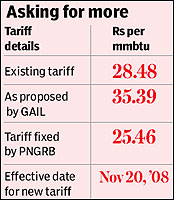
PNGRB issued tariff regulations on November 20, 2008. Before that, tariff for GAIL’s pipeline was fixed by the Tariff Commission. The tariff of Rs 28.48 per mmbtu fixed by the commission for the pipeline is subject to adjustment retrospectively from the date of issuance of the tariff regulations by PNGRB.

GAIL has been charging tariff of Rs 28.48 per mmbtu on an adhock basis for transportation of gas via the pipeline. But in its proposal submitted to PNGRB, the gas transporter sought tariff of Rs 35.39 per mmbtu on the basis of extra capital expenditure incurred by it on maintenance. However, PNGRB moderated levelised tariff to Rs 25.46 per mmbtu.


PNGRB considered only 70% of the extra capital cost claimed by GAIL. Similarly, in its tariff proposal submitted to PNGRB, GAIL had envisaged volume divisor at 90% of the design capacity of 57.30 million standard cubic meter per mmscmd.

However, the regulator considered the volume divisor at full design capacity. Similarly, PNGRB reduced inflation rate by 0.5% and fully discounted transmission losses while fixing tariff for the pipeline. The new rate will be applicable retrospectively from November 20, 2008.

Source: Finacial Express
_______________________________________________________________________________________

April 13, 2010

Create separate price pools for power, fert: GAIL expert

An advisor hired by state-owned natural gas distributor Gail India has recommended separate price pooling for power and fertiliser producers—the major users of natural gas who will increasingly depend on imported natural gas that has high price volatility. In a study commissioned by Gail on natural gas at the behest of the petroleum ministry, Mercados Energy Markets India has strongly suggested that price pooling should not be mandatory for all producers and consumers, but should be applicable for power and fertilizer makers. These two sectors alone consume about two third of the 132-million standard cubic meters a day (mmscmd) natural gas produced in the country.

In many countries, pooled price is used to reduce the volatility and unpredictability in the price of agricultural produce so that both the farmers and the consumers benefit. Under the proposed scheme, gas producers would continue to get the price that they are entitled to as per their production sharing contract with the government, but gas consumers would get it at a uniform price. The government wants price pooling because power and fertiliser makers, who would increasingly rely on imported gas in the future, are unable to make major investments because gas price is linked to crude price that is subjected to high volatility. Growth in both the sectors is essential for meeting the needs of a fast growing economy. Their growth will also facilitate creation of a strong network of gas pipeline across the country.

“We recommend separate pools for the two sectors to avoid cross subsidies between the customer groups and administration issues that a combined pool would present,” said Mercados in its report. The consultant has also recommended Gail as the administrator of the proposed pools because it already has experience in pooling of re-gasified liquefied natural gas. The operator has to allocate gas on an arms length basis. The cost-based sectoral pool does not require any legislative changes.

Introducing it only for the power and fertiliser industries leaves adequate room for an alternate market to develop for other industries and even for power and fertiliser makers who do not wish to be a part of the pool. This would facilitate price discovery for new gas supplies. While the benefits of cost pooling is not restricted to the power and fertiliser sectors only, Mercados did not suggest it for other sectors such as petrochemicals as it could get more complex and drive up costs Sectoral pool brings price stabilisation in selected sectors, leaving the other sectors free to access their supplies from other sources.

Natural Gas from various sources will become a part of these pools. The operator will assess the demand and allocate gas as per the gas utilisation policy. Mercados said there was no need for pooling of transport charges as it leads to inefficiency. Natural gas’ share in the country’s total energy basket is predicted to go up from 10% now to 25% in the next 15 years. The new demand is estimated to come mainly be from power and fertiliser sectors....

Source: Financial Express
__________________________________________________________________________________

GAIL to invest Rs 15,000 cr by 2013 to lay pipelines

State-owned gas firm GAIL India will invest about Rs 15,000 crore over the next 2-3 years in laying pipelines to connect consumption centres in North India to fuel sources. 

Addressing a meet organised by PHD Chamber of Commerce and Industry here, GAIL Chairman and Managing Director B C Tripathi said his company was laying new pipelines to connect cities like Uttar Pradesh, Uttrakhand, Punjab and Haryana. 

Pipelines are planned to connect cities like Meerut, Saharanpur and Moradabad in UP, Dehradun in Uttrakhand, Bhatinda and Nangal in Punjab and Panipat, Hissar and Gurgaon in Haryana by 2013. 

"Gas demand in northern India is expected to grow at the rate of 20-25 per cent over the next 2-3 years. To meet this demand, we are investing Rs 15,000 crore in laying new lines," he said. 

Besides, GAIL is expanding its 10,700 km of cross-country pipeline network. It is laying 5,000 km of pipeline to connect gas sources on the western coast to consumption centres in the north by 2013. 

Of this, about 1,000-km pipeline length would be commissioned by year end and 1,500 km would be added every year over the next two years. 

GAIL is also laying pipelines to connect to Bangalore, Mangalore and Kochi in next 3-4 years. 

Tripathi said the share of natural gas in the energy basket will rise to 12 per cent by 2012-13 from current 10 per cent. Current supplies of about million standard cubic meters per day is short of demand of 230 mmscmd. 

Domestic gas production, he said, will rise to 170-175 mmscmd in the next 4-5 years from 135 mmscmd currently after new fields of companies like Oil and Natural Gas Corp (ONGC) and Gujarat State Petroleum Corp (GSPC) come online. 

GAIL Chairman, however, cautioned that future gas supplies may not come cheap. Liquefied natural gas (LNG) from international suppliers like Qatar was available at no less than 14-15 per cent of crude oil price

At prevailing crude oil price of USD 80-85 per barrel, this translates into a gas price of around USD 10 per barrel, more than double the rate at which Reliance Industries sells gas from its eastern offshore KG-D6 fields. 

"I don't think that prices are going to come into as demand is bound to go up with the revival of world economy," he said. "Long term LNG supplies are not available at prices at which gas is available from domestic fields."

Source: Economic Times
__________________________________________________________________________________
December 14, 2009

GAIL may tap D6 gas for southern pipelines

GAIL (India) Ltd is looking at the D6 block and re-gassified liquefied natural gas (R-LNG) as probable sources of gas for its ongoing Dabhol-Bengaluru and Kochi-Kanjirkkod-Bengaluru-Mangalore pipeline projects.


“Each network will have the capacity to transport 16 mscmd of gas. The probable sources of gas are the Krishna Godavari Basin (D6 block operated by Reliance Industries Ltd), R-LNG from Dabhol and Petronet LNG's under-implementation Kochi terminal,” official sources told Business Line.


Currently GAIL is ferrying about 28 mscmd of D6 block gas to customers in Andhra Pradesh, Maharashtra and Gujarat. Its 7,100-km pipeline network is transmitting about 120 mscmd of gas from various sources including D6 block.


GAIL was authorised to lay the Dabhol-Bengaluru and Kochi-Kanjirkkod-Bengaluru-Mangalore pipelines by the Petroleum Ministry in 2007. The projects would be completed by 2012-13. The company is investing Rs 7,575.43 crore, with a foreign exchange component of Rs 212.02 crore, in the two projects.


For the 1,389-km Dabhol-Bengaluru pipeline project, the GAIL Board had approved an investment of Rs 4,543.43 crore, including a foreign exchange component of Rs 193.45 crore.


The pipeline with capacity to transport 16 mscmd of gas will be implemented in two phases and the spur lines/feeder lines will also be laid alongside.


The 1,114-km Kochi-Kanjirkkod-Bengaluru-Mangalore pipeline project, with an investment of Rs 3,032 crore including foreign exchange component of Rs 18.57 crore, has been designed to transmit 16 mscmd of gas including four mscmd as common carrier.


Beneficiaries from this network will include SEZ Vyapin Kochi, Cochin Minerals, Binani Zinc, BPCL refinery, Apollo Tyres and Kozhikode-KESEB Power plant.
Source: Hindu Business Line
__________________________________________________________________________________

July 17, 2009

GAIL to lay down 600-km long gas pipeline in MP

Gas Authority of India Limited (GAIL) will lay down a 600-km long gas pipeline from Jhabua to Kailaras in Madhya Pradesh at an estimated cost of Rs 3,000 crore, a top company official said today.

The proposed gas pipeline from Jhabua to Kailaras covering a distance of nearly 600 km will be laid at an estimated cost of Rs 3,000 crore," GAIL Chairman U D Choubey told reporters at the company's Vijaypur plant.


"It will have a visible impact in the area in the next two-three years," he said.


The cost of the pipleline between the two points (Jhabua and Kailaras) will be Rs 2,500 crore while another Rs 500 crore will be spent on installing two compressors, the Chairman said.


GAIL has already laid down 6000 km long gas pipeline in India and has plans to lay down a pipeline of equivalent length across the country, he said.


The company also plans to supply piped gas in a radius of 50 km in the cities situated along the route of the pipeline and nearly 230 cities and towns including Guna, Indore, Gwalior and Malanpur have been shortlisted for the purpose, Chobey said.


__________________________________________________________________________________